
Classes by level, not by age

Krav maga has no competition. People come to learn how to defend themselves — and your page has to answer that worry without feeding it.
An adult membership, no competition calendar, levels set in-house, and a promise that has to be worded exactly right.
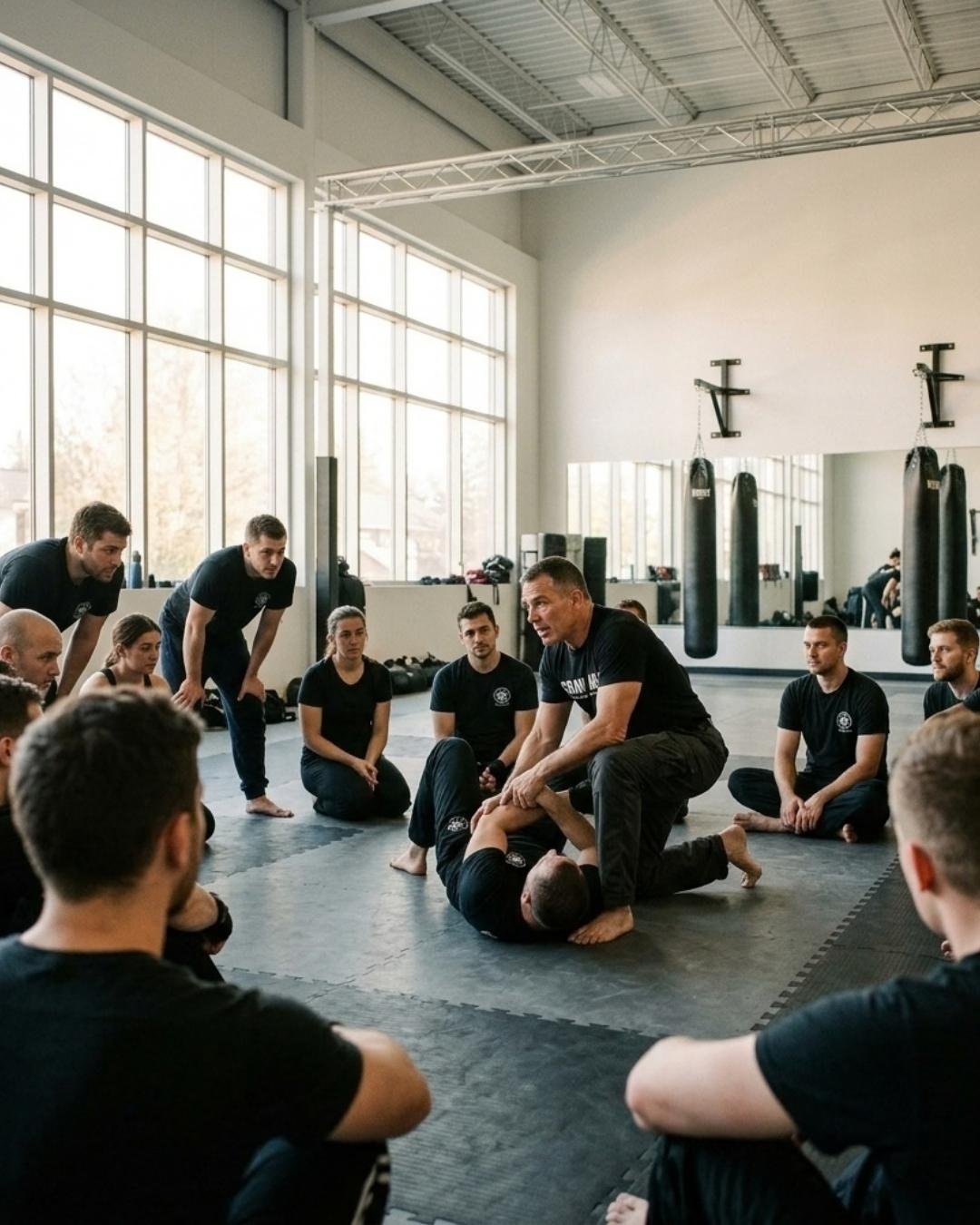
Beginner, intermediate, advanced. Level is earned on the mat, not set by a date of birth; the timetable should reflect that.
Weapon defence, ground attacks, urban situations. These are what bring people back and what fill your weekends.
Strong demand, and often poorly served. A dedicated slot, advertised as such, brings in people who would never come otherwise.
With no competition, what counts is turning up. A membership collected automatically builds the habit better than a class pass.
Classes by level, not by age

Themed workshops

Women-only sessions
Termly or annual membership
The searches say it plainly: "krav maga" plus the town, "self defence", "self defence for women".
This audience is looking for reassurance. A page that promises invincibility is lying; a page that explains what you learn, how long it takes, and what it does not replace inspires far more confidence.
Spell out the level of fitness required — often none — and the minimum age. Two objections removed in a single sentence.
There are multiple organizations and certifications are uneven. Showing yours, with the name of the organization and the level of the instructor, distinguishes a serious club.
The professional card remains required to teach for remuneration, regardless of internal certification.
Prudence of language. Promising to “neutralize an aggressor” commits; describe techniques and training, no.
A visitor arrives with three questions: where, when, and how to sign up. Everything else comes after. Building a site that fills your sessions therefore starts with the address of the gym, the times of every class and a visible registration button. Then comes what makes people want to join: the method you teach, the instructor's experience, the atmosphere on the mat.
Each page should answer one precise intent. A single page that talks about everything ranks for nothing. The guide on the content of an association website sets out the sections useful to any organisation; here are the ones that count for a krav maga club.
What a short video gets across, no paragraph ever will. Film a warm-up, a drill in pairs, the end of a class. Those videos show the respect between partners, the real pace of the work, and the fact that the discipline stays within reach of an adult starting out. Add subtitles, because many people watch with the sound off.
Searches are local and short: a town name, sometimes a neighbourhood. Some people write kravmaga as a single word. Others type the name of a club a colleague recommended, looking for its official site. Your site has to be findable along all three routes at once.
Many clubs go by a three- or four-letter acronym, something like KMVM, that nobody knows how to spell. The association is sometimes registered under a compound name, for example "association kmbr : krav maga et self défense". Use that exact name on your Google business listing, on your site and in the sports directories: a well-chosen directory brings links and consistent information. It is that consistency which lifts a club in front of someone searching close to home.
Krav maga has no single governing body. So say which federation or which organisation you have chosen to affiliate with, and since when. Spell out what you ask for at registration: medical certificate, insurance, proof of identity. For sessions open to under-18s, the background check on coaching staff applies as it does in any martial art, and saying so reassures parents. Clubs in the same family, whether a karate club or a martial arts and MMA gym, face the same expectations.
Between the search and the first session there are four or five clicks. Any one of them can derail the whole thing. A phone number as the only way in loses you half your enquiries: people do not ring a stranger to ask about a self-defence class. An online booking system removes that obstacle at a stroke.
Your club remains responsible for the personal data it collects: contact details, medical documents, information about minors. A simple, honest page is enough to explain it. The last mistake on the list is the most expensive: a social page cannot be search-optimised, does not belong to you, and vanishes with the next change of algorithm. A website builds on itself, season after season.
You do not have to become a webmaster. We build a bespoke website, designed and search-optimised for your activity, then we plug in what keeps the club running: an online schedule with sessions bookable around the clock, booking with limited places, a waiting list and automatic reminders, and payment taken at the time of booking through Stripe.
Behind the site you have bespoke software and an iOS and Android mobile app under your own brand. The emails go out without you: confirmations, follow-ups, campaigns to announce a new round of seminars. The result shows quickly — full sessions, registrations paid for without chasing anyone, and far less admin on a Sunday evening.
There are two ways to start. Talk to an expert: we look at your classes, your levels and your seminar calendar together. Or launch your free 14-day trial, with no card details, and create your first sessions yourself.
Yes — a class with its own access conditions and its own timetable.
As a limited-places service over a day or a weekend, paid at registration.
That is exactly what your audience is asking — and the answer belongs on your page, not in a back-and-forth of messages.
That depends on how you run the club. If you hold them, they are tracked on the member's record like grades.
The real work is gathering your classes, your levels, your prices and your copy. We put the structure and the search optimisation in place, you sign off on the content. As soon as the timetable is in, the site can start taking registrations.
It is there to show the life of the club, not to be found. Someone looking for a club nearby goes through a search engine, and a post does not rank. The site remains the only address you control, and it is the site that collects the registrations.
Yes. Every student has a record with their level, their documents, their bookings and their subscription. Renewals and reminders are triggered automatically by email. You stay in control of what is collected and what is displayed.
Three things genuinely help: one page per class and per seminar, the same name everywhere (site, Google listing, directories, federation), and a site that is fast on a phone. Nobody can guarantee a position in the results, but a site structured around your activity starts a length ahead of a generic brochure site.